


The Vietnam Mechanical Business Association believes that there will be many opportunities for the Vietnamese mechanical industry in the near future. However, seizing said opportunities can be difficult.
An opportunity market
According to the Department of Industry, Vietnam has about 25,000 operating mechanical enterprises, accounting for nearly 30% of the country’s total number of processing and manufacturing enterprises. Vietnam’s mechanical engineering industry gradually masters and improves the localization rate, creating motivation to promote other industries and economies to develop, creating jobs for millions of workers.
Vietnam’s mechanical engineering industry develops strongly in three sub-sectors:
- Motorcycles and motorcycle parts
- Mechanics and household tools
- Automobiles and auto parts.
These three sub-sectors account for nearly 70% of the country’s total mechanical industry production value.
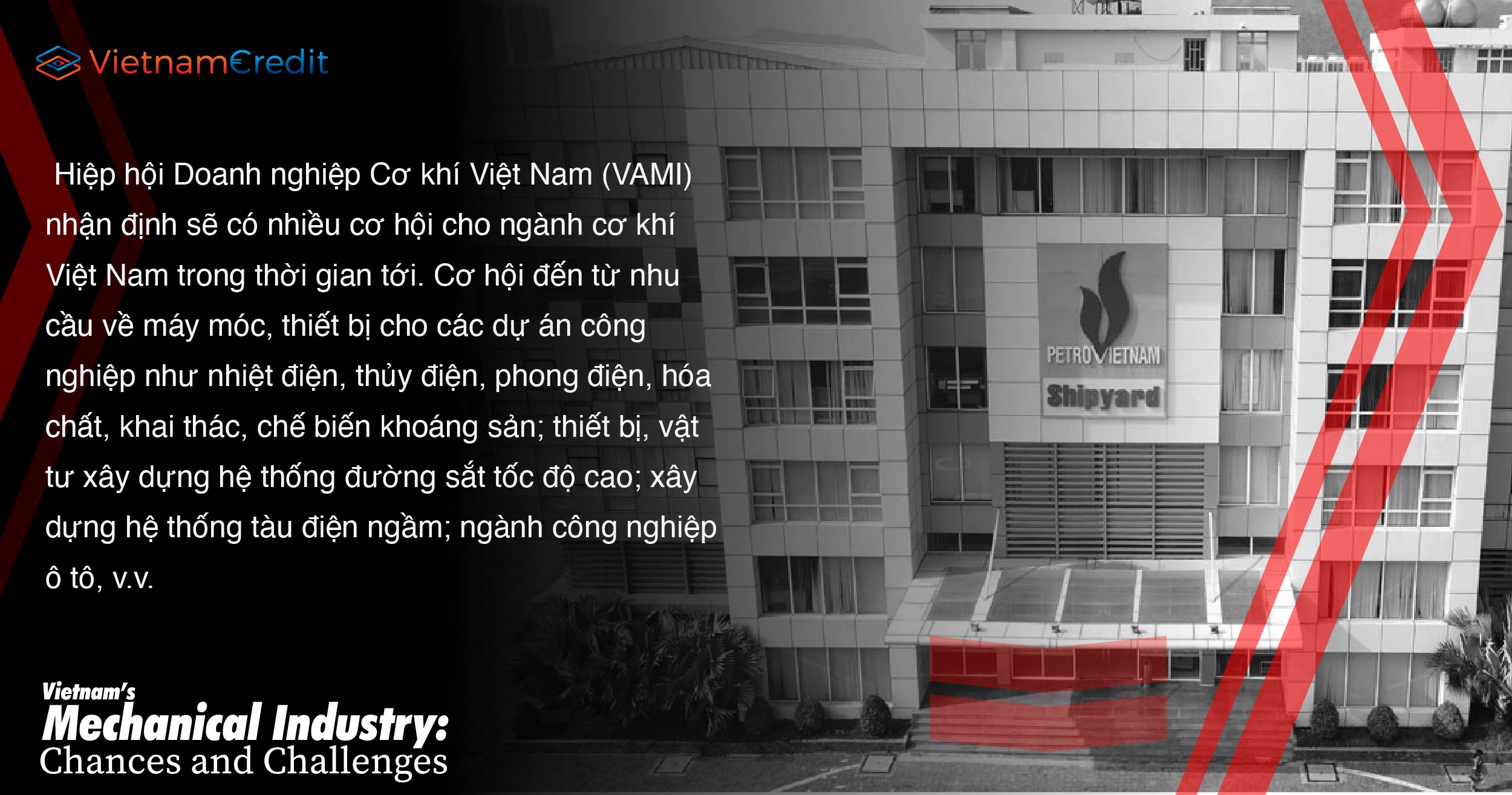
Vietnam Association of Mechanical Enterprises (VAMI) believes that there will be many opportunities for the Vietnamese mechanical industry in the near future. Opportunities come from the need for machinery and equipment for industrial projects such as thermal power, hydropower, wind power, chemicals, mineral exploitation and processing; equipment and materials for high-speed railway system construction; building a subway system; automobile industry, etc.
Mr. Nguyen Chi Sang, Vice President and General Secretary of VAMI, gave a specific example: According to Power Plan VIII, in the wind power segment, the expected capacity by 2045 is 40,000 MW and can be expanded, the price Installation and production value will bring about 40 billion USD to the mechanical industry.
Sharing the same opinion, Mr. Nguyen Quang Hieu – General Director of PetroVietnam Maritime Shipyard Joint Stock Company (PV Shipyard), has an optimistic view on the future of Vietnamese mechanical enterprises.
Mr. Hieu shared specific analysis of a hypothetical offshore wind power project. Equipment that the mechanical industry can do is to manufacture propellers, wind columns, base systems, etc. The base system for an offshore wind power project requires at least 35-40 columns. It is expected that the investment capital for the basic system is about 300,000 tons of equipment per year. Each ton is equivalent to 4,000 USD, including raw material costs. Thus, on average each year there will be about 1.2 billion USD market share for Vietnamese mechanical enterprises.
That will be a big market in the next 5 years. Not only that, Vietnam is being chosen by the US, Denmark, Norway,… to replace China as a place to both produce and manufacture wind power equipment to supply markets in regional countries.
Major partners are paying attention to Vietnam and Korea. In this race, Korea is more proactive because it has steel plates available as raw materials. However, wind power in the Vietnamese market has greater potential, specifically in terms of market share, remote seaport location, etc.
Obstacles in the way?
Despite such abundant potential, Vietnam’s mechanical engineering industry still seems to be facing difficulties. Seizing said opportunities can be difficult.
Vietnam’s mechanical engineering industry is facing obstacles. First, Vietnam’s mechanical enterprises are still small. Second, lack of connection and development. Vietnamese mechanical companies tend to operate spontaneously and fragmented business activities.
In addition, VAMI believes that, in recent years, with limitations and weaknesses coming from mechanical enterprises and the State’s management mechanisms and policies, the development of the mechanical industry has remained weak and unsatisfactory. request.
Vietnamese mechanical enterprises do not capture much market share, even in the domestic market, and always lack orders. Many large projects in construction, transportation, irrigation, oil and gas, marine economy, shipbuilding, cars, motorbikes… mainly use imported mechanical products or are undertaken by FDI enterprises.
In 2012, the Government approved the Mechanical Industry Development Strategy, and in 2018 there was an update to suit the new situation.
However, up to now, the following mechanisms and policies still do not exist. There are no good policies. Therefore, while the mechanical market is large, Vietnam’s mechanical enterprises are still struggling.
Mechanical enterprises still have to mobilize and develop on their own without effective support from the State’s policy system to receive many orders from public investment and large projects. For example, recently approved and invested wind power projects have not been linked to the mechanical industry, so domestic mechanical enterprises cannot participate.
